



Stackable Washer Dryer Repair: The Fault Is Usual, the Access Is Not
Your washer is on the bottom, your dryer is on top, and one of them has quit. Unplug both before you open or move anything.
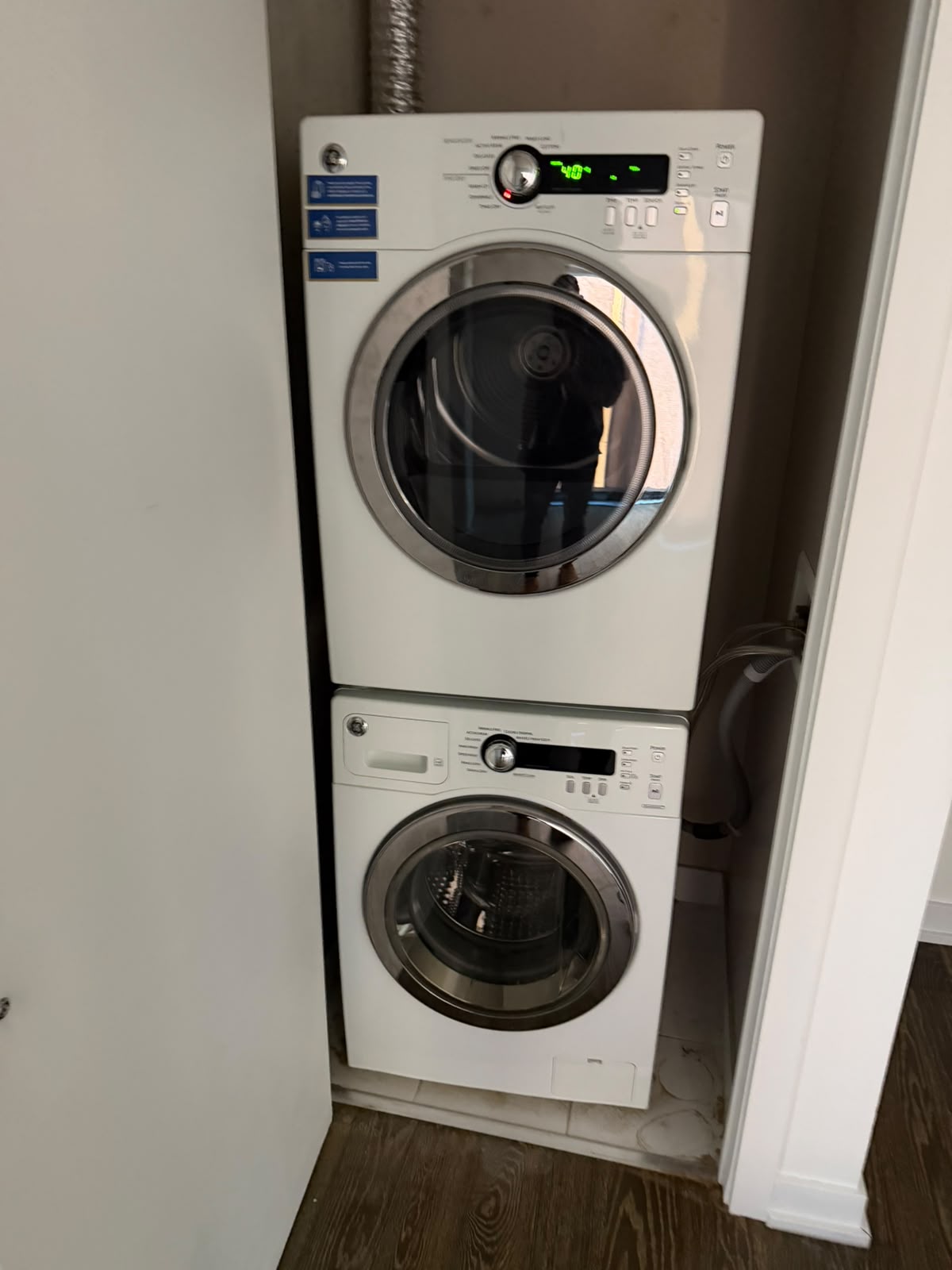
Most stackable washer dryer repair is ordinary work on ordinary faults: drain failures, spin problems, worn bearings or rollers, and a dryer that won’t heat. In our work the failures match what we see on side by side machines. Stacking changes the access: reaching the part, moving the stack safely and checking the installation.
Start with what the machine is doing, because that decides who should fix it.
Faults You’ll See on a Stacked Washer and Dryer
A stack fails the way two separate machines fail. These are the four symptoms people arrive with:
- Washer won’t drain or spin. A failed motor coupling can stop the spin. It’s built to break under overload to protect the motor and transmission, and a worn drive belt can cause the same symptom. That comes from a single top-load example, so it may not apply to a front-loader. On a top loader, a failed lid switch stops the spin even though the washer fills and agitates normally. Our post on top load lid lock repair covers that one.
- Noise and vibration. Worn bearings or rollers make noise. A loud washer spin has its own set of causes, and what a noisy dryer means is a separate question.
- Dryer has no heat. Usually the thermal fuse or the heating element.
- Dryer won’t turn. Usually the belt, the idler pulley or the motor.
Vibration is the fault that comes with stacking. An unbalanced load, worn suspension or poor levelling can make the whole tower shake. Check the feet and the stacking kit before you assume an internal part has failed. Tight closets add two more problems. They can kink the drain hose and crush the dryer’s exhaust duct, and either one looks like a drain or drying fault.
Does anything fail only because the units are stacked? Usually no. The stacking kit, the mounting brackets and installation vibration are the closest examples.
We won’t put a percentage on which fault is most common in stacks. We’d want real service records behind a number like that, and the answer changes between a laundry center and two machines stacked together.
When Stackable Washer Dryer Repair Needs a Technician
Call a technician for anything involving the motor, the drum seals, the control board or the heating system. In practice that means a weak drive motor, damaged drum seals, control board faults, and gas or electric heating faults. A broken drive belt is the usual line between a homeowner job and a technician job, and the belt section below walks through it.
Call right away if the breaker trips every time the washer starts. Stop resetting it and unplug the machine. Repeated trips suggest a short in the motor, the control board or the wiring, and that is a possible fire hazard.
What a visit on a stack involves. Many repairs start with separating the units. The list reportedly includes the thermal fuse, heating element, blower wheel, drum rollers, felt seal, motor, belt, control board, and the washer pump and drain system. It varies with the type of unit. Separating adds roughly 45 minutes to over an hour of access time before the repair even starts, and longer if the stacking kit has rusted or the machines are wedged into a tight space. That is extra labour even when the replacement part is ordinary.
If the part isn’t on the van, you may need a second visit. Parts for older machines can push a repair past the first call.
Repair or replace. Washers are said to last about 10 to 14 years and dryers up to about 14. As a rule of thumb, a quote above about half the price of a replacement points toward replacing, especially on an older machine. On a stack, replacing both halves or buying a new stacking kit can change that sum.
Safety and Access Before Anyone Touches the Stack
Unplug the machine before you do anything else. On a gas dryer, shut the gas valve off as well, and leave disconnecting the gas line to a technician. If the dryer has just run, let it cool first.
Next, find out whether your stack can be pulled forward as one piece or has to be separated. That depends on the stacking kit or the laundry center design, and the installation sheet or the owner’s manual will say. Some manufacturers’ instructions need two people to lift the dryer. A laundry center shares a frame with the washer, so you can’t simply unstack it like two separate machines.
For a separate pair, the order is:
- Unplug both machines.
- Shut off the water supply to the washer.
- Disconnect the electrical and plumbing connections. You’ll need an adjustable wrench or pliers for the plumbing.
- Get a helper.
- Remove any screws holding the two units together, using a screwdriver.
- Lift the dryer off first, then separate the units. Move them on a dolly.
This is generic advice, not tied to any brand or stacking kit. If you don’t have a helper, a dolly or the installation sheet, stop here and book a technician.
A Repair You Can Do Yourself: The Dryer Drive Belt
A broken drive belt is the one dryer repair most treated as a homeowner job. Unplug the dryer first, shut the gas off on a gas model, and separate the stack if your installation sheet says the dryer has to come off the washer.
You’ll need a putty knife, a Phillips screwdriver and a 5/16-inch nut driver. The steps below suit a typical dryer where the front panel comes off. Your dryer’s layout may differ, and our dryer repair guide covers more of the general ground.
- Lift the top panel.
- Disconnect the door-switch harness.
- Remove the front panel.
- Lift the drum.
- Route the new belt around the drum.
- Thread the belt through the idler pulley and loop it over the motor pulley. Seating it on the motor pulley may take some extra effort.
- Check that the idler pulley is tensioning the belt.
- Reconnect the door-switch wires, refit the front and top panels, plug the dryer in and run a test cycle.
Belt access differs by design. On a condenser or heat-pump dryer, the motor has to come out, the rear panel has to be pulled back and the drum axle nut has to be removed. The motor can slide about 1 cm to adjust belt tension. A guide written for one layout won’t transfer to another, so find steps for your model.
If the belt is fine and the drum still won’t turn, the fault is probably the idler pulley or the motor. A weak motor is a technician job.
Separate Pair, Laundry Center or Combo: Why the Type Changes the Repair
The type of stack changes how hard the repair is, even when the fault is the same.
Separate pair. This is usually the quickest to access, because each machine can be serviced independently. Each machine has its own control panel, so a fault in one doesn’t stop the other. It is also easier to replace one half without losing both, though an old and a new half may not stack together if the old model is outdated. That last point is about replacement, not repair.
Laundry center. This is more awkward. The washer and dryer share a frame and run from one control panel, so you can’t simply unstack them like two separate machines.
Combo. One drum and one cabinet both wash and dry. Repairs are often more involved when the fault is in the drying or condensation system, because the wash and dry functions share the same drum. A combo is a different machine from a laundry center.
Tell any technician which of the three you have. It changes the access, the time and the parts.
Six Free Checks to Run Before You Book
Unplug the stack before you reach behind it. These checks cost nothing, and any one of them may be the whole fix.
- Power. Test the outlet by plugging in a lamp or a phone charger. Re-seat the plug too, because spin-cycle vibration can work it loose.
- Breaker. If the outlet is dead, flip the breaker fully off, then on. A dryer that tumbles but doesn’t heat can have a double breaker that is only half tripped. If a breaker trips every time the washer starts, that is not a free check. Stop resetting it and call a technician.
- Door latch. If the display is lit but Start does nothing, close the door firmly and listen for a click. The interlock blocks the cycle if it can’t confirm the door is closed, even when the door feels shut.
- Vent. Look for lint build up in the dryer’s vent, and check that the exhaust duct behind the stack isn’t crushed.
- Drain filter. A blocked drain pump filter can stop a washer draining. Why a washer won’t drain lists what else to check.
- Levelling. Adjust the feet so the stack stops walking, and check the stacking kit.
If none of these changes anything, stop and book a technician. Tell them which type of stack you have, what the machine does or doesn’t do, and whether a breaker has tripped. There’s no phone number or booking link on this page, so use whatever contact details you have for a local appliance repair service.

