



Can a Control Board Be Repaired? Usually, Yes
Can a control board be repaired? More often than people expect. A lot of what fails on a board is a single component, not the whole thing, and replacing one part costs a lot less than replacing the entire board. If you’re dealing with this right now, our control board repair service can take a look, but it helps to know what you’re actually up against first.
People tend to assume the worst the moment an appliance starts acting up electronically. A dead display or an unresponsive panel feels like the end of the road, but usually it’s just one small piece inside a much bigger board doing all the work.
What Actually Fails Inside a Board
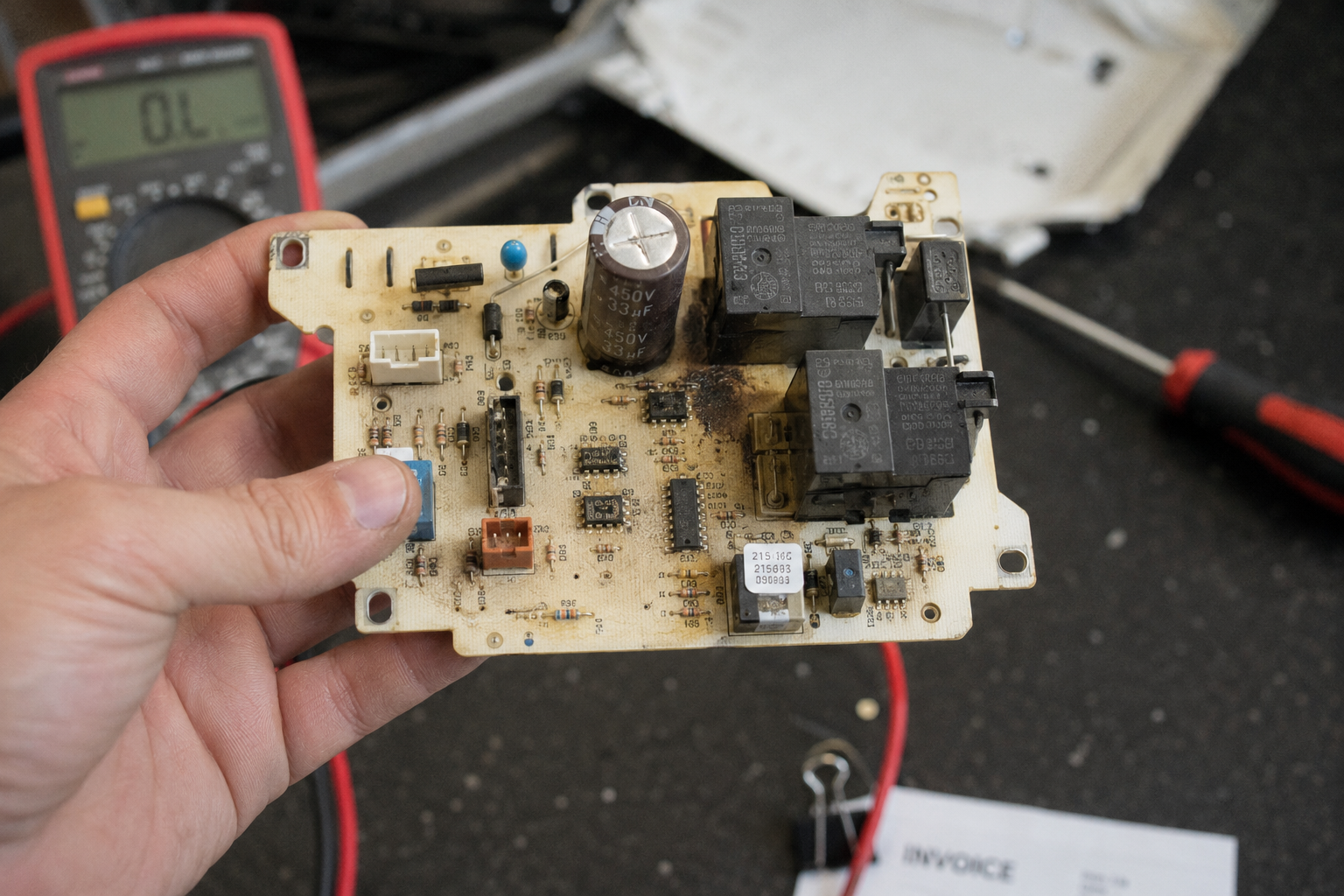
It’s rarely the whole board that dies. Usually it’s one component, a capacitor, a relay, or a solder joint cracked from years of heating and cooling. You can often swap capacitors and relays out directly. A cracked joint sometimes just needs reflowing, melting the solder again so it makes proper contact.
Figuring out which one actually caused the failure is the tricky part. That’s why a proper diagnosis matters more than ordering a part and hoping. A board can have a dozen components on it, and only one of them is actually the problem. Replace the wrong one and the appliance still won’t work, and now you’ve paid for a part you didn’t need.
Capacitors especially deserve a second look. They store and release electrical charge, and years of heating and cooling can make them swell, leak, or quietly lose their ability to hold a charge. Heat is usually the culprit, it degrades the electrolyte inside faster than normal aging would. Spot one bulging or leaking and you’ve probably found your fix, and it’s usually a cheap one.
Where the Failure Shows Up Depends on the Appliance
Ovens run their boards through real heat exposure, cycle after cycle. Dishwashers expose theirs to steam and moisture, corrosion is the usual culprit there. With fridges, if everything else tests fine but performance still isn’t right, the board’s often the answer.
Washers and dryers see a bit of both worlds. Vibration from the spin cycle can loosen connections over time. Dryers deal with heat cycling similar to ovens, just less intense. Knowing which pattern fits your appliance narrows things down before you even open the panel.
A flickering display means something different depending on what it’s attached to. On a dishwasher, that points toward moisture and corrosion first. On an oven, heat damage tells the more likely story. Same symptom, different appliance, different suspect.
Can a Control Board Be Repaired? Check It Visually First
Unplug the appliance and pull the board out. Look for burn marks, cracks, or corrosion. A board with nothing obviously damaged is usually a decent repair candidate.
A board that’s visibly burned, cracked, or corroded through changes the calculation, repair gets a lot less reliable once the damage runs that deep. Extensive corrosion in particular tends to spread. It eats into traces and connections beyond just the one obvious spot, which makes a full repair harder to guarantee.
Take a photo before you touch anything. It’s a small step, but it gives you a reference if you need to compare notes with a technician later, or if you’re trying to source a replacement part and need to confirm exactly what you’re looking at.
When Repair Makes More Sense Than Replacing
Cost is the big one. A new control board generally costs more than fixing the specific failed component, sometimes considerably so. If your appliance is otherwise in good shape and this is the first real issue it’s had, repair is usually the smarter call.
Availability matters too. Some replacement boards, especially for older or discontinued models, can be hard to track down or take weeks to arrive. Repairing the original board sidesteps that wait entirely.
When Replacement Is the Better Call
A board that keeps failing again after being fixed is telling you it’s genuinely worn out, not just unlucky. Multiple failed components at once point the same direction. And if the appliance itself is getting up there in age, sinking money into board repair on its own doesn’t always make sense.
It’s also worth looking at the appliance as a whole. If other parts are already showing wear, a board repair might buy you a few more months rather than several more years, and that’s worth talking through with whoever’s doing the repair before you commit either way.
Can a Control Board Be Repaired Yourself?
To a point. A confident DIYer can sometimes spot an obvious burnt component or a cracked solder joint and fix it. But testing individual components properly takes real equipment and experience, and so does knowing which ones actually caused the failure versus which ones just look suspicious.
Guess wrong and you’ve spent money on a part that wasn’t the problem. Worse, some DIY attempts can damage a board that was otherwise still repairable, turning a fixable problem into one that genuinely does need a full replacement.
If you’re trying to figure out whether a control board can be repaired in your specific case, our control board repair in Toronto guide covers what we actually check before recommending repair or replacement.


Comments (2)
Signs of a Bad Control Board, Explained
[…] with visible electrical damage isn’t worth the risk. If the damage looks minor, check whether a control board can be repaired in your case before you assume it needs full […]
Oven Control Board Failure: What Actually Causes It - Appliance Doc
[…] service covers the diagnosis and the fix. We serve North York and Thornhill directly, and our can a control board be repaired guide walks through whether yours is worth fixing before you assume it needs full […]