




Signs of a Bad Control Board: What to Actually Watch For
Most people don’t think about the control board until something’s acting up in a way that doesn’t make sense. If your appliance is doing something that doesn’t add up, our control board repair service can take a look. Recognizing the real signs of a bad control board first saves you from replacing a part that was never the problem.
It Has Power, But Won’t Do Anything
Lights on, display working, buttons responding, but the appliance just never starts the cycle. That’s one of the clearest tells. Everything downstream checks out fine. The board just isn’t sending the signal that kicks things off.
This one trips people up because it feels backwards. If the appliance seems responsive, the instinct is to assume the problem’s elsewhere, a bad switch, a stuck lock, a sensor. But when every individual system checks out and the appliance still won’t run, the board not issuing the start command is usually what’s left. A multimeter can confirm this, dryers and ranges should read 240 volts AC at the right test points, and if that voltage isn’t reaching where it should, the board’s the reason.
The Same Error Code Keeps Coming Back
You clear it, reset the appliance, and it returns almost immediately. Even after you’ve checked or replaced the part the code points to. I’ve had customers swap the exact sensor a code named, twice, before finally calling us. The board was never getting accurate information from a good sensor in the first place. A second good sensor never had a chance to fix anything.
Buttons Take a Few Tries, or Don’t Respond at All
You press once, nothing happens. You press again, it finally works. Or it never responds at all. This shows up a lot on ovens, ranges, and dishwashers specifically.
A worn-out button usually fails the same way every time, always stiff, always slow. This is different. It works fine for a few days, then lags for no reason, then works fine again. That inconsistency is the tell. It means the board’s communication with the touchpad is breaking down internally, not one physical switch just wearing out.
The Display Is Dim, Flickering, or Missing Segments
The display often shows trouble first, before anything else acts up. A weak or failing board can’t always deliver clean, steady voltage to it. That gets you flickering, dimness, or parts of the display that just stop lighting up.
It’s tempting to ignore since the appliance still runs fine otherwise. Don’t. This is usually the earliest visible sign the board’s power delivery is starting to fail, well before that same instability affects anything the appliance actually needs.
Cycles Stop Mid-Way or Restart on Their Own
A wash cycle pauses randomly, or a bake resets itself halfway through. The board loses track of where it’s supposed to be in the sequence. It’s disruptive because it doesn’t look like a single, obvious failure. It looks like the appliance forgot what it was doing.
The same load might run fine three times and then stall on the fourth for no clear reason. A mechanical part that’s failing tends to fail the same way every time. A board losing its place mid-cycle doesn’t, and that unpredictable pattern is usually the giveaway.
Signs of a Bad Control Board You Don’t Need a Meter For
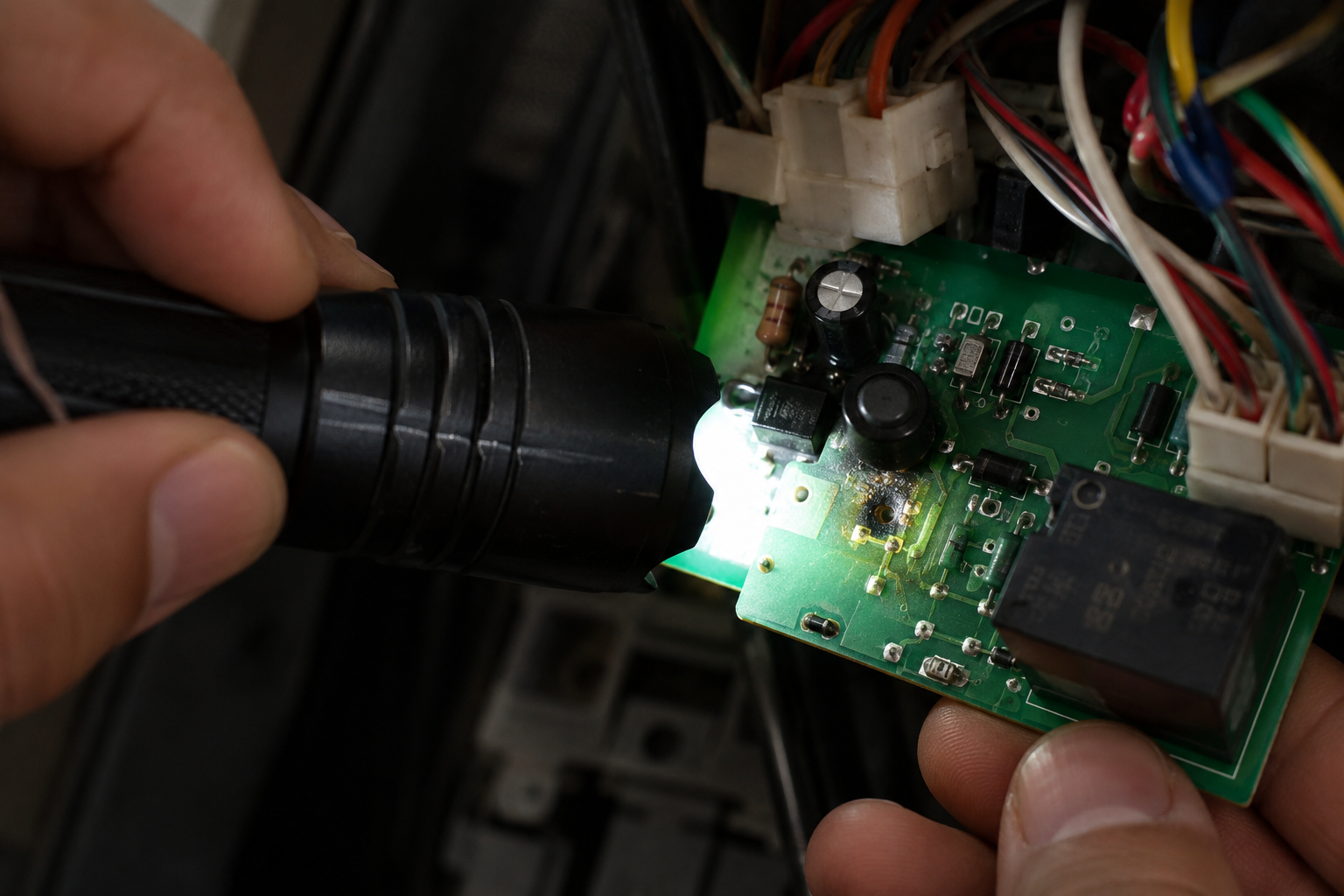
Pull the panel and look. Scorch marks, melted plastic, a bulging capacitor, or corrosion around the components are about as direct a sign as you’ll get. If you can see it, you don’t need to guess anymore.
Everything else on this list is worth troubleshooting further before assuming the board’s at fault. Not this one. Unplug the appliance and stop there. It confirms the board, and running something with visible electrical damage isn’t worth the risk. If the damage looks minor, check whether a control board can be repaired in your case before you assume it needs full replacement.
Sensors Test Fine, But the Appliance Still Acts Up
This is the trickiest one. You test the temperature sensor, the water sensor, whatever’s relevant, and it comes back within spec. The oven still runs hot. The dishwasher still won’t finish its cycle properly.
We see this one a lot with older ovens especially. The parts check out fine on paper, but the board itself is misreading data it’s already getting. If you’ve already swapped a sensor once and nothing changed, that’s your cue to stop testing individual parts and start looking at the board instead.
Recognizing the real signs of a bad control board early saves you from a repair bill built on the wrong guess. Our control board repair in Toronto guide walks through what we actually check before recommending repair or replacement.


Comments (2)
Reliable Appliance Repair Company: How to Find One
[…] turns out something electronic is acting up rather than a straightforward mechanical failure, our signs of a bad control board guide is worth a look before you assume the […]
Oven Control Board Failure: What Actually Causes It - Appliance Doc
[…] and constant thermal cycling, so the causes tend to be specific to what ovens actually do. Our signs of a bad control board guide covers the general symptoms. This one’s about what drives oven control board failure in […]